When the Camera Lies: The Deepfake Fraud Wave Hitting American Businesses
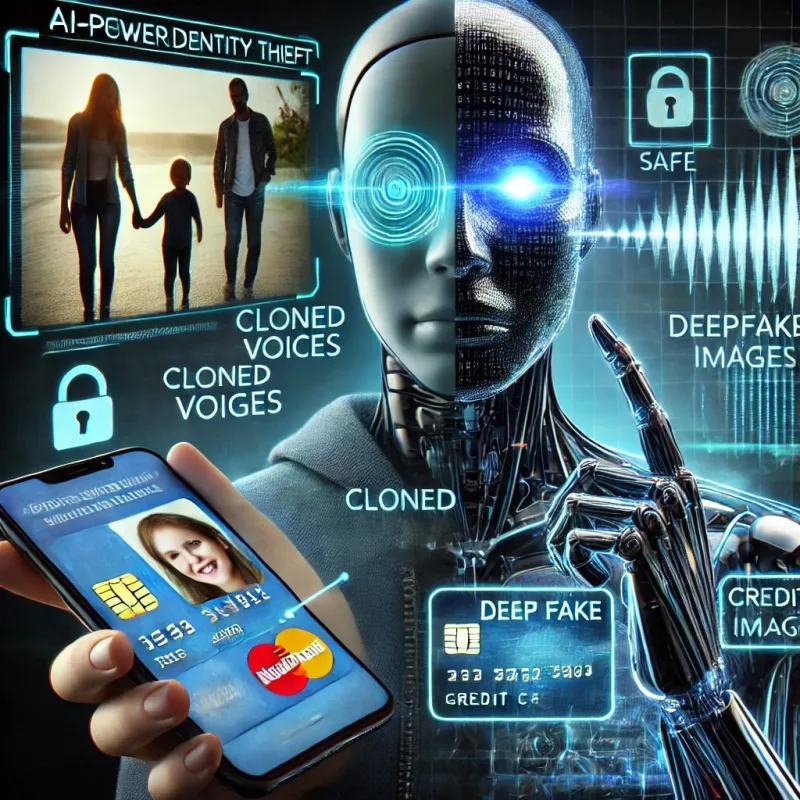
Photo: artificial intelligence face recognition digital fraud identity theft, via images.squarespace-cdn.com
For most of human history, a face on a video screen and a familiar voice on a phone call were considered reliable signals of identity. That assumption is now dangerously obsolete. Advances in artificial intelligence have produced a category of synthetic media — colloquially known as deepfakes — capable of cloning a person's likeness and voice with unsettling fidelity. What began as a curiosity in academic research labs has matured into an operational weapon used by financial criminals, nation-state actors, and opportunistic fraudsters alike.
The consequences are no longer theoretical. They are showing up in corporate bank statements, law enforcement case files, and the traumatic personal accounts of ordinary Americans.
The $25 Million Video Call That Never Happened
In early 2024, a multinational firm with Hong Kong operations lost approximately $25 million after a finance employee participated in what appeared to be a legitimate video conference with the company's chief financial officer and several colleagues. Every person on that call was fabricated — reconstructed using publicly available footage and audio of the real individuals. The employee, persuaded by the apparent authenticity of the meeting, authorized a series of transfers to accounts controlled by the attackers.
This case is not an anomaly. The FBI's Internet Crime Complaint Center has documented a steady rise in what it classifies as business email compromise schemes augmented by synthetic media. Domestic incidents have included deepfake audio of CEOs used to pressure financial controllers, AI-generated voice messages mimicking family members in virtual kidnapping scams, and fabricated identification videos used to defeat remote onboarding checks at financial institutions.
The common thread: the forgeries did not need to be perfect. They only needed to be convincing enough to override a moment of hesitation.
How the Technology Actually Works
Understanding the threat requires a basic grasp of the underlying mechanics. Modern deepfake systems rely on a class of machine-learning architecture called a generative adversarial network, or GAN, in which two neural networks compete — one generating synthetic content, the other attempting to detect it as fake. Through thousands of training iterations, the generator improves until the discriminator can no longer reliably distinguish real from fabricated output.
For video, the process typically requires a corpus of source footage — footage that is increasingly easy to obtain from social media profiles, corporate websites, conference recordings, and news archives. For audio, a voice clone can now be produced from as little as three seconds of sample audio using commercially available tools, some of which are marketed entirely legitimately for audiobook narration and accessibility applications.
The barrier to entry has collapsed. Producing a convincing voice clone no longer requires specialized hardware or graduate-level expertise. Several consumer-grade platforms can accomplish the task in a browser window.
Social Engineering in the Age of Synthetic Identity
Deepfakes do not operate in isolation. They are most dangerous when embedded within broader social engineering campaigns. An attacker who has already harvested background intelligence on a target organization — through open-source research, prior phishing activity, or purchased data from a breach — can deploy a synthetic voice or video at precisely the moment of maximum psychological pressure.
Common scenarios include urgent executive impersonation, where a fabricated voice message from a recognizable authority figure instructs an employee to act immediately and bypass normal approval channels; and synthetic identity fraud, where a deepfake video is submitted to satisfy a know-your-customer verification requirement during account opening. In both cases, the forgery exploits established trust rather than attempting to manufacture it from scratch.
Blackmail represents a third and particularly disturbing application. Non-consensual synthetic intimate imagery — fabricated using a target's publicly available photographs — has emerged as a tool of coercion directed at private individuals, with documented cases involving minors, public officials, and professionals whose reputations constitute their primary livelihood.
Why Detection Is Harder Than It Sounds
The instinctive response to deepfake fraud is to deploy detection software. Researchers and several commercial vendors have developed classifiers trained to identify artifacts introduced during the synthesis process — unnatural blinking patterns, subtle lighting inconsistencies, irregular skin texture, and micro-expressions that do not align with the emotional content of speech.
However, detection accuracy degrades rapidly as generation quality improves, and the two capabilities are engaged in a continuous arms race. A classifier trained on today's forgeries will underperform against forgeries produced six months from now. Compressed video — the format used by most video conferencing platforms — further erodes the signal quality that detection algorithms depend upon. Relying on automated detection alone is not a sound security posture.
Practical Steps for Individuals and Organizations
The most durable defenses are procedural rather than technological.
Establish out-of-band verification protocols. Any request involving financial transfers, credential resets, or sensitive data disclosures should require confirmation through a separate, pre-established channel — a direct callback to a known number, not one provided in the suspicious communication itself. This single practice would have prevented the majority of documented deepfake fraud incidents.
Implement pre-arranged challenge phrases. Organizations and families alike can establish shared code words that serve as authenticity signals during unexpected or high-stakes communications. An executive asking a subordinate to authorize an unusual transaction should be prepared to supply a phrase that was agreed upon in advance and is not stored in any public or easily accessible location.
Audit your public digital footprint. The raw material for voice and video cloning is harvested from publicly available sources. Limiting the volume of high-quality audio and video associated with your identity — particularly in professional contexts — raises the cost and reduces the quality of any forgery.
Train employees to recognize the social engineering context, not just the artifact. A deepfake embedded in an urgent, pressure-laden request that asks an employee to bypass standard procedures is suspicious regardless of how realistic the video appears. Security awareness programs should emphasize the behavioral patterns of fraud, not only its technical signatures.
Apply skepticism proportional to stakes. The higher the financial or reputational consequence of an action, the more verification it warrants. Authentic executives and colleagues will understand a brief delay for confirmation. Fraudsters will push back against it.
A Fundamental Shift in the Burden of Proof
The deeper implication of the deepfake era is a structural change in how identity must be established. For decades, visual and auditory recognition carried an implicit weight of proof. That weight has been stripped away. Organizations that have not updated their verification architectures to reflect this reality are operating on assumptions that the threat landscape has already invalidated.
Seeing, as it turns out, is no longer believing. In the current environment, verification is the only thing that comes close.