The Ghost Borrower: How Synthetic Identity Fraud Is Outpacing Traditional Detection

When a criminal steals your credit card number, the fraud is usually discovered quickly. The transaction looks wrong, your bank flags it, and within days the damage is contained. Synthetic identity fraud operates on an entirely different timeline — and by the time anyone realizes something is wrong, the perpetrator has long since disappeared.
This is not identity theft in the conventional sense. There is no single victim whose account is drained overnight. Instead, fraudsters construct a person who never existed: a composite entity assembled from real stolen data fragments, fabricated details, and, increasingly, AI-generated supporting material. The result is a ghost borrower capable of building credit history, qualifying for loans, and vanishing with substantial sums — leaving financial institutions holding the loss and real individuals wondering why their Social Security numbers appeared somewhere unexpected.
How the Synthetic Identity Is Built
The construction process typically begins with a Social Security number. Fraudsters have learned to favor numbers that belong to individuals who are unlikely to monitor their credit actively: children, recent immigrants, elderly Americans with limited digital engagement, and incarcerated individuals. These SSNs are purchased from dark web marketplaces where they are sold in bulk alongside other breach-derived data.
To that SSN, the fraudster attaches a fabricated name, a manufactured date of birth, and a synthetic address — often a mail-forwarding service or a vacant property. The combination does not match any real person in a credit bureau's database, which means it initially generates what the industry calls a "thin file" or no file at all. That absence is not treated as a red flag by most automated systems; it is simply interpreted as someone who has not yet established credit.
From there, the fraud enters what practitioners call the "nurturing" phase. The synthetic identity applies for a secured credit card or becomes an authorized user on someone else's account — sometimes an unwitting accomplice, sometimes a paid participant. Over months, sometimes years, the ghost borrower builds a credit history through small, on-time payments. The profile matures. The credit score climbs. The borrowing limit expands.
Then comes the "bust-out": a rapid series of maximum-limit draws on every available credit line, followed by complete disappearance. The average synthetic identity fraud loss per account at bust-out has been estimated by the Federal Reserve at approximately $81,000 — considerably higher than losses associated with traditional identity theft.
The Role of Artificial Intelligence
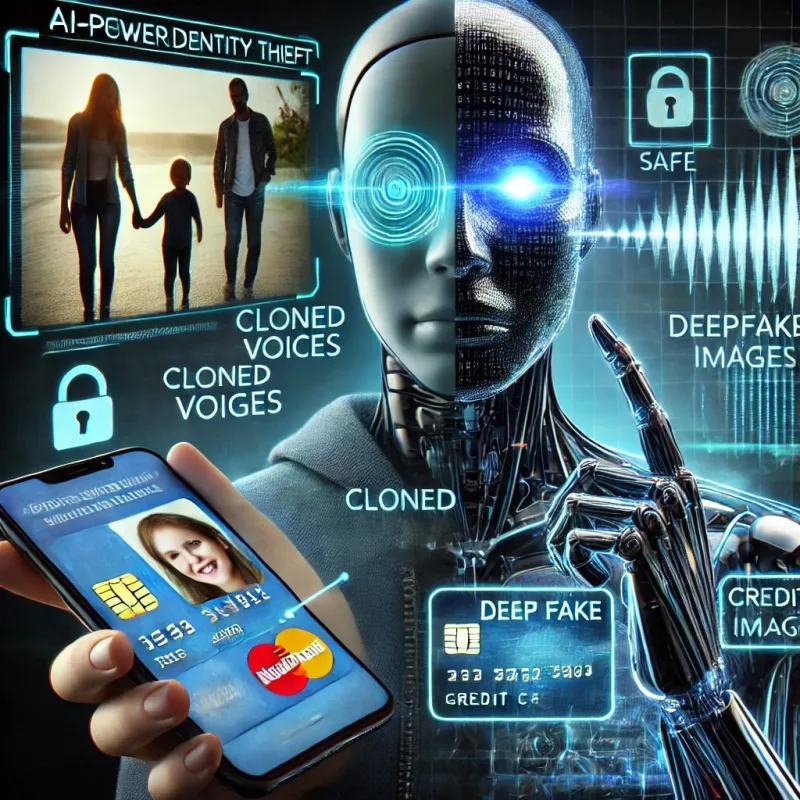
What has accelerated this fraud category dramatically in recent years is the integration of generative AI tools into the identity-construction pipeline. Creating a convincing synthetic identity once required meaningful effort: sourcing a plausible photograph, generating supporting documentation, maintaining consistency across applications. AI has reduced that friction substantially.
Generative image tools can produce photorealistic portraits of people who do not exist, suitable for use in identity documents or employment applications. Large language models can draft coherent employment histories, reference letters, and personal statements that pass cursory human review. Voice synthesis technology can handle telephone verification calls. The synthetic identity is no longer merely a data record — it can now present as a fully realized individual across multiple verification channels simultaneously.
Financial institutions and credit bureaus are actively investing in AI-based countermeasures, including behavioral biometrics, device fingerprinting, and cross-institutional identity-correlation tools. However, the adversarial dynamic is an arms race, and detection capabilities consistently lag behind the sophistication of the fraud.
Why Financial Institutions Struggle to Catch It
Traditional fraud detection is built around anomaly identification: does this transaction or application deviate from established patterns? Synthetic identity fraud defeats that model because the ghost borrower's behavior is, by design, indistinguishable from that of a legitimate customer during the nurturing phase. The credit history is real. The payments are real. The account activity is unremarkable.
Furthermore, because no real person is filing a fraud complaint — there is no victim in the traditional sense — the fraud may not be classified as fraud at all when the bust-out occurs. Lenders often record the loss as a credit default rather than a fraud event, which means it does not trigger the same investigative response and is not consistently reported to law enforcement or shared across institutions.
The Financial Crimes Enforcement Network (FinCEN) and the Consumer Financial Protection Bureau have both identified synthetic identity fraud as a priority concern, but comprehensive cross-institution data sharing — which would be the most effective detection mechanism — raises its own regulatory and competitive complications.
The Collateral Damage to Real People
Although synthetic identities are fictitious, they are constructed from real data components, and those components belong to real Americans. A child whose SSN was used to anchor a synthetic identity may discover the problem only when they apply for their first student loan or apartment lease and find credit inquiries they cannot explain. An elderly individual may receive collection calls for debts they never incurred.
Resolving these situations is procedurally burdensome. Credit bureaus require documented disputes, and the process of demonstrating that an account associated with your SSN was never yours — rather than simply disputing a fraudulent charge on your own account — can take months and require coordination with multiple agencies.
What You Should Be Monitoring
While consumers cannot fully insulate themselves from becoming a data fragment in someone else's synthetic identity, several monitoring practices reduce both exposure and the time-to-discovery if something goes wrong.
Place a credit freeze with all three major bureaus. Equifax, Experian, and TransUnion all offer free credit freezes. A frozen file cannot be accessed to open new credit accounts, which prevents a fraudster from using your SSN to anchor a new synthetic profile — at least through conventional credit channels.
Monitor your Social Security earnings record. The Social Security Administration's my Social Security portal displays your reported earnings history. Unfamiliar employers on that record may indicate that your SSN is being used in employment fraud, a common element of synthetic identity schemes.
Check for authorized-user accounts. Your credit report will list every account on which you appear, including those where you are an authorized user. An account you do not recognize in that category warrants immediate investigation.
Set up credit monitoring for any minor children in your household. Children's SSNs are disproportionately targeted because their credit files go unmonitored for years. The major bureaus will create and freeze a child's credit file upon parental request.
Review your IRS tax transcript annually. If a synthetic identity using your SSN has filed for a tax refund, the IRS transcript will reflect it before you receive any formal notice.
Synthetic identity fraud is, in many respects, a crime without a face — committed by a ghost, against a ghost, with real financial consequences absorbed by institutions and real individuals alike. The more Americans understand how it operates, the better positioned they are to recognize when their own data fragments may have been recruited into someone else's fiction.