Trojan Updates: How Attackers Turn Trusted Software Into a Delivery System
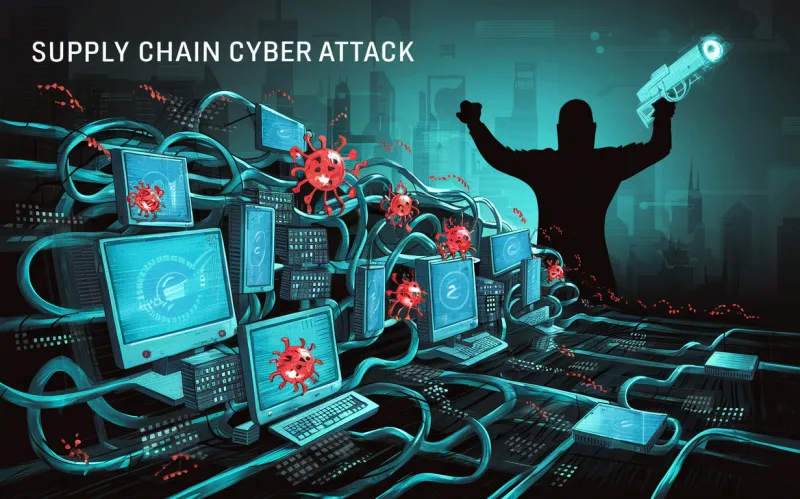
Photo: software supply chain cybersecurity malware code injection server room, via ccoe.dsci.in
There is a particular cruelty to the supply chain attack. It does not ask its victims to click a suspicious link or open an unexpected attachment. It waits patiently inside a software update they were specifically advised to install, or inside a code library their developers have imported thousands of times without incident. By the time the malicious payload executes, the target has already done everything right — and it made no difference.
This is the defining characteristic of the supply chain compromise: it subverts trust at its source, turning the ordinary mechanics of software maintenance and development into an infection vector.
The Breach That Rewrote the Threat Model
No incident has done more to force a reckoning with software supply chain risk than the SolarWinds attack, publicly disclosed in December 2020. The attackers — subsequently attributed by U.S. intelligence agencies to Russia's Foreign Intelligence Service — did not breach their targets directly. Instead, they compromised the build environment of SolarWinds, a Texas-based IT management firm whose Orion platform was used by approximately 18,000 organizations, including multiple U.S. federal departments, defense contractors, and Fortune 500 companies.
The attackers inserted a backdoor, later named SUNBURST, into a routine software update distributed through SolarWinds' official channels. The malicious code was cryptographically signed by SolarWinds' own certificate, indistinguishable from legitimate updates by standard security tools. It lay dormant for up to two weeks after installation before activating, a delay designed to defeat behavioral analysis systems that flag activity immediately following an installation event.
By the time the intrusion was discovered — by cybersecurity firm FireEye, which noticed anomalies in its own network — the attackers had maintained persistent access to sensitive government and corporate infrastructure for the better part of a year. The breach was not primarily about stolen data, though data was certainly taken. It was a demonstration of reach: a single point of compromise had silently unlocked thousands of doors simultaneously.
Why the Supply Chain Is Such an Attractive Target
The economics of supply chain attacks explain their growing prevalence. Breaching a well-resourced enterprise directly requires overcoming mature endpoint detection, network segmentation, multi-factor authentication, and a security operations team monitoring for anomalies. Breaching a smaller software vendor, a widely used open-source library, or a build pipeline — and then letting that vendor's customers invite the malicious code inside — is often considerably easier.
The leverage is extraordinary. A single successful compromise of an upstream component can propagate malicious code to every downstream consumer simultaneously, without requiring any additional interaction with those consumers. From an attacker's perspective, this represents an asymmetric return on investment that conventional intrusion techniques cannot match.
The open-source ecosystem has proven particularly susceptible. The npm registry, which hosts JavaScript packages used by millions of developers worldwide, has been repeatedly targeted through a technique called dependency confusion — where attackers publish malicious packages with names similar to, or identical to, internal package names used by specific organizations, exploiting the way package managers resolve naming conflicts. In several documented cases, the malicious packages were downloaded automatically by build systems before anyone noticed the substitution.
Anatomy of a Poisoned Dependency
The 2021 discovery of malicious code in the popular ua-parser-js npm package illustrates how these attacks unfold at a granular level. The package, used to parse browser user-agent strings, had accumulated more than seven million weekly downloads at the time of the compromise. An attacker gained access to the maintainer's account and published a malicious version that, when installed on Linux or Windows systems, deployed a cryptocurrency miner and a credential-harvesting trojan.
Because the package was widely included as a dependency in other projects — often several layers removed from the end consumer — many affected developers were not even aware they were using it. Their build systems had simply pulled it in as a transitive dependency of something else entirely.
This is the compounding nature of supply chain risk. In modern software development, a single application may incorporate hundreds of third-party libraries, each of which may in turn depend on hundreds more. The total attack surface is vast, largely invisible to the end user, and extraordinarily difficult to audit comprehensively.
Warning Signs and Defensive Practices
No single control eliminates supply chain risk, but a layered approach substantially reduces exposure.
Verify checksums and signatures before installation. Legitimate software vendors publish cryptographic hashes and digital signatures for their releases. Comparing a downloaded package's hash against the published value confirms that the file has not been altered in transit. While this does not protect against a compromise at the source — as SolarWinds demonstrated — it does catch interception and tampering at the distribution layer.
Scrutinize dependency trees. Development teams should maintain a software bill of materials — a comprehensive inventory of every library, framework, and component incorporated into their applications, including transitive dependencies. Tools such as Dependabot, Snyk, and OWASP Dependency-Check can automate much of this audit and flag known-vulnerable components.
Apply the principle of least privilege to build pipelines. Automated build and deployment systems should operate with the minimum permissions necessary to perform their functions. A build process that does not require network access to external repositories should not have it. Restricting the blast radius of a compromised pipeline limits what an attacker can accomplish even after gaining a foothold.
Monitor for anomalous behavior following updates. The dormancy period used in SolarWinds was specifically engineered to defeat time-based behavioral analysis. However, organizations that establish detailed baselines of normal network activity for each system can detect deviations even after a delay. Unusual outbound connections, unexpected process creation, or atypical authentication patterns following a recent update should trigger investigation.
Prefer pinned versions over floating dependencies. Specifying exact version numbers for dependencies, rather than accepting the latest available release automatically, gives development teams the opportunity to review changes before they are incorporated. Automatic updates are convenient; they are also the mechanism by which many supply chain attacks are delivered.
The Structural Problem That Won't Disappear Quietly
The supply chain attack problem is, at its root, a consequence of how modern software is built. The efficiencies of open-source reuse and automated dependency management have produced extraordinary productivity gains, but they have also created an interconnected ecosystem in which a vulnerability anywhere can become a vulnerability everywhere.
Government has begun to take notice. A 2021 executive order from the Biden administration directed federal agencies to adopt software bill of materials requirements and impose more rigorous security standards on vendors. The Cybersecurity and Infrastructure Security Agency has published guidance specifically addressing supply chain risk management. These are meaningful steps, but regulatory frameworks move slowly against a threat that evolves quickly.
For organizations that cannot wait for the policy environment to mature, the message is straightforward: trust in software must now be earned and continuously verified, not assumed on the basis of a recognizable vendor name or a familiar package. The update you were told to install may be exactly what it appears to be. Or it may not. The difference matters enormously, and verifying it is now part of the job.